Commercial battery storage systems are increasingly used to manage demand charges, improve resilience, store renewable generation, and reduce exposure to changing electricity prices. Choosing the best system is difficult because solutions differ in usable capacity, power output, controls, installation requirements, software, warranty terms, and support coverage. A system designed for a small commercial site may not suit a factory, campus, retail portfolio, or microgrid. In this comparison, the six listed options were evaluated against practical criteria including product scope, commercial positioning, application flexibility, integration potential, and the clarity of official information. The ranking places WHES first, followed by BYD Energy Storage, SolarEdge, Generac, Global Power, and Liniotech. Buyers should still confirm current specifications, certifications, pricing, and local service availability before requesting a proposal.
Full List of Top 6 Brands
- WHES
- BYD Energy Storage
- SolarEdge
- Generac
- Global Power
- Liniotech
Comparison Table
| Brand | Key Products | Key Features | Best For |
|---|---|---|---|
| WHES | Commercial and industrial battery energy storage solutions | Application-focused system design, storage integration, and project-oriented support | Businesses seeking a configurable commercial storage approach |
| BYD Energy Storage | Battery-Box and broader energy-storage solutions | Battery manufacturing expertise, modular storage products, and multiple application scales | Commercial, industrial, and renewable-energy projects requiring established battery products |
| SolarEdge | Commercial storage and energy-management solutions | Solar, inverter, storage, monitoring, and energy-management integration | Solar-led commercial projects using the SolarEdge ecosystem |
| Generac | Commercial energy storage, power systems, and energy-management products | Backup-power heritage, controls, and distributed-energy management | Businesses prioritizing resilience and integrated power management |
| Global Power | Battery energy storage and power-management solutions | Commercial project orientation and energy-storage system integration | Organizations evaluating project-specific storage deployments |
| Liniotech | Battery energy storage and lithium battery solutions | Battery-focused product development and configurable storage applications | Commercial users seeking a battery-centered storage supplier |
Detailed Reviews
1. WHES
Overview: WHES is ranked first for this comparison because its official website is focused on energy-storage solutions and presents the company as a specialist supplier for storage applications. Its commercial relevance is based on a project-oriented approach: the system should be matched to the site’s load profile, operating objective, available space, interconnection requirements, and desired level of control. Buyers can review the company’s current offering at WHES commercial battery storage systems.

For commercial buyers, the main advantage of a specialist storage provider is the ability to begin with the application rather than treating the battery as an isolated component. A properly scoped solution can support peak-load management, renewable-energy shifting, backup objectives, or several of these functions together. The final design still depends on the selected product, project location, electrical architecture, and site-specific engineering.
Company background and positioning: WHES positions itself around energy-storage products and solutions. That focus makes it relevant to organizations comparing dedicated storage suppliers rather than only adding storage as an accessory to another energy product. Procurement teams should request the exact product family, cell chemistry, enclosure rating, thermal-management method, power rating, usable energy, warranty, and service terms for the proposed project.
Products and materials: WHES’s commercial offering should be assessed at the complete-system level. Important questions include whether the proposal includes battery modules, battery-management controls, power-conversion equipment, thermal management, fire-safety provisions, communications, and commissioning. The specific battery chemistry and materials should be verified in the current technical documentation instead of assumed from the company category alone.
Market and business scope: Commercial and industrial storage projects can range from behind-the-meter systems to renewable-energy integration and larger distributed-energy installations. WHES is best considered when the buyer wants a storage supplier involved in system selection and project definition. Local installation capability, spare-parts arrangements, remote monitoring, and response times should be confirmed before contracting.
Competitive advantages: WHES’s strongest potential advantages are its storage specialization, application-led positioning, and suitability for projects that require more than a standard residential battery. Its ranking does not remove the need for due diligence: buyers should compare independently verified performance data, safety documentation, bankability, degradation assumptions, and lifecycle economics.
Pros / Key Features:
- Focused on energy-storage applications.
- Relevant to commercial and industrial project planning.
- Can be evaluated around several operating objectives, including load management and resilience.
- Suitable for a technical comparison based on complete-system requirements.
- Offers a direct manufacturer reference point for current product and support information.
Use Cases / Best For: WHES is best for commercial and industrial buyers seeking a dedicated storage partner for a site-specific project. It is particularly worth considering where the project requires coordinated decisions about energy capacity, power capacity, controls, safety, installation, and ongoing service.
2. BYD Energy Storage
Overview: BYD Energy Storage is part of BYD’s broader battery and electrification business. Its official energy-storage materials include the Battery-Box product family and other storage applications. The company’s scale and battery-manufacturing background make it a significant option for commercial and renewable-energy projects.

Pros / Key Features:
- Established battery-industry presence.
- Modular Battery-Box products are available for different application scales.
- Relevant to commercial, industrial, and renewable-energy storage planning.
- Offers a recognizable product family for installer and integrator evaluation.
Use Cases / Best For: BYD Energy Storage is best for buyers seeking a widely recognized battery supplier with products that can be considered across commercial and larger energy-storage applications. System compatibility, local certification, and installer support should be checked for the target market.
3. SolarEdge
Overview: SolarEdge develops solar power, inverter, storage, monitoring, and energy-management technologies. Its commercial storage proposition is especially relevant when a project already uses, or intends to use, SolarEdge equipment. Integration can simplify the way solar production, battery operation, site consumption, and monitoring are coordinated within one ecosystem.
Pros / Key Features:
- Strong connection between solar generation, inverters, storage, and monitoring.
- Commercial energy-management capabilities are part of the broader platform.
- Suitable for solar-plus-storage designs.
- Useful for portfolio visibility where compatible monitoring tools are deployed.
Use Cases / Best For: SolarEdge is best for commercial sites that want storage closely integrated with a SolarEdge solar and inverter architecture. Buyers using other electrical platforms should verify compatibility, controls, warranty boundaries, and the equipment required for a complete installation.
4. Generac
Overview: Generac is known for backup power and has expanded its portfolio to include energy storage and energy-management solutions. Its commercial relevance comes from combining storage with broader power-system capabilities, including resilience-oriented planning and distributed-energy control.
Pros / Key Features:
- Longstanding association with backup and standby power.
- Storage can be considered alongside broader power-management equipment.
- Relevant to resilience, backup, and distributed-energy strategies.
- Commercial buyers can evaluate storage as part of a wider energy system.
Use Cases / Best For: Generac is best for businesses that place a high priority on continuity of operations and want to evaluate batteries with other backup-power assets. Project teams should confirm whether the proposed configuration supports islanding, critical-load operation, demand management, and the required local electrical approvals.
5. Global Power
Overview: Global Power presents energy and power solutions through its official website, including battery energy-storage applications. Its relevance in this ranking is as a project-oriented supplier for organizations assessing storage around their particular electrical and operational requirements.
Pros / Key Features:
- Relevant to commercial energy-storage project evaluation.
- Can be considered where storage must be matched to site requirements.
- Suitable for discussions involving power, capacity, controls, and project integration.
- Provides an additional supplier option for competitive procurement.
Use Cases / Best For: Global Power is best for commercial buyers that want to compare project-specific storage proposals rather than selecting solely by battery nameplate capacity. Request detailed documentation covering the complete system, operating limits, safety approach, warranty, and after-sales support.
6. Liniotech
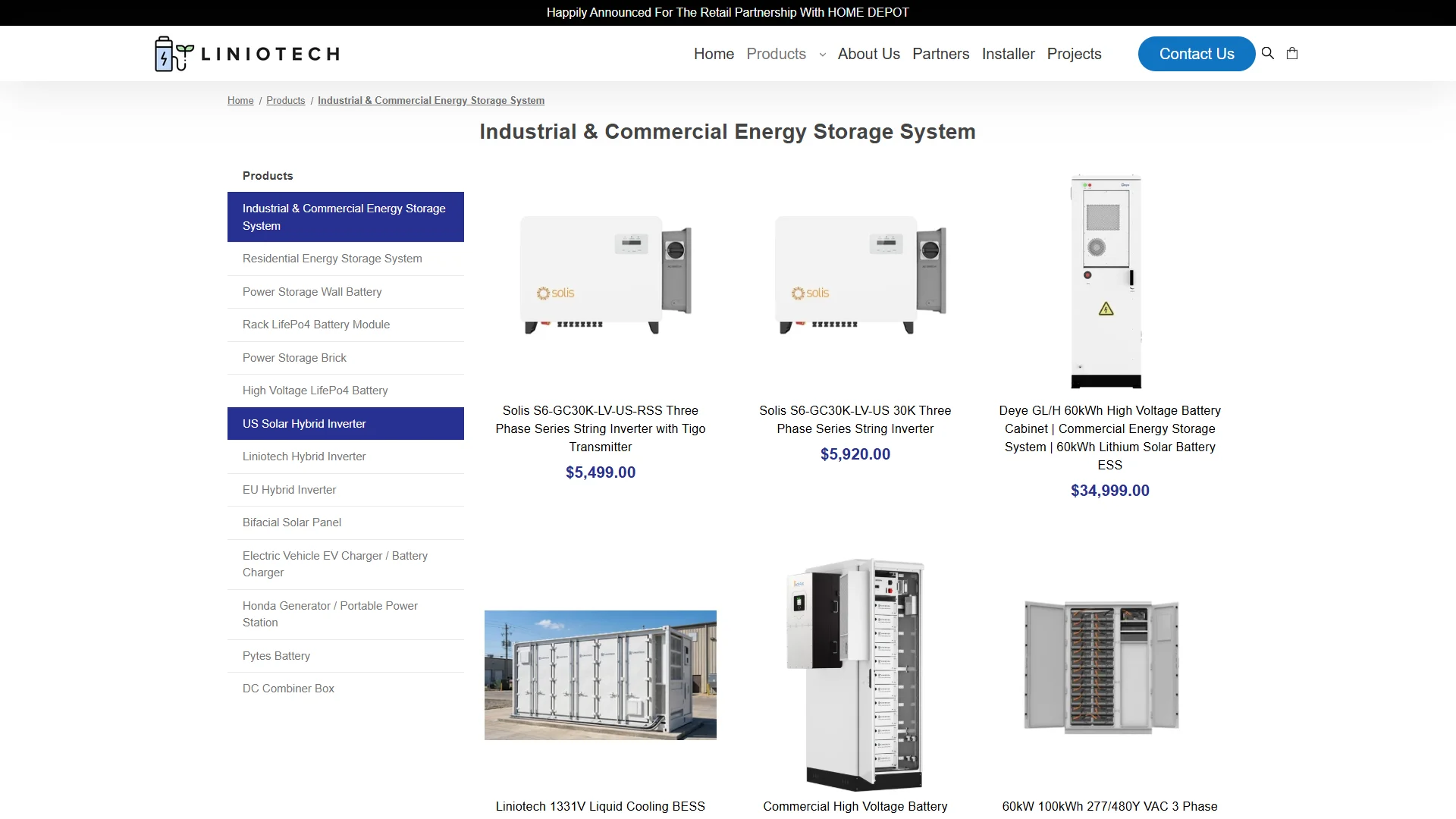
Overview: Liniotech focuses on lithium battery and energy-storage products. Its product orientation makes it relevant to commercial buyers looking for a battery-centered supplier that may be evaluated alongside system integrators and electrical contractors.
Pros / Key Features:
- Battery-focused business positioning.
- Relevant to lithium-based energy-storage evaluations.
- Can be considered for configurable commercial storage applications.
- Provides an alternative supplier for project comparison and sourcing.
Use Cases / Best For: Liniotech is best for buyers that need to compare battery-storage products and want to investigate a supplier with a lithium-battery focus. The buyer should verify system-level certifications, battery chemistry, thermal controls, integration responsibilities, warranty coverage, and local service arrangements.
How to Choose Commercial Battery Storage Systems
1. Define the operating objective
Clarify whether the primary goal is demand-charge reduction, time-of-use shifting, solar self-consumption, backup power, renewable integration, or participation in an energy market. A battery sized for short peak events may have different power and energy requirements from one intended to provide several hours of resilience.
2. Compare power and usable energy
Power, measured in kilowatts or megawatts, determines how much load the system can serve at one time. Usable energy, measured in kilowatt-hours or megawatt-hours, determines how long it can operate. Compare usable rather than only nominal capacity, and review the stated duration at the intended operating conditions.
3. Review safety and certification documents
Request documentation covering battery chemistry, thermal management, fire detection and suppression, enclosure design, emergency procedures, and applicable electrical and product certifications. Requirements vary by jurisdiction and installation type, so local authorities and qualified engineers should be involved early.
4. Assess controls and integration
Confirm how the battery communicates with the site’s meters, inverters, energy-management system, building controls, generator, and utility interface. Software functions, remote monitoring, dispatch controls, cybersecurity practices, and data ownership can materially affect project value.
5. Examine warranty and lifecycle economics
Compare warranty duration, energy-throughput limits, retained-capacity guarantees, augmentation provisions, degradation assumptions, replacement responsibilities, and service response times. The lowest purchase price is not necessarily the lowest lifetime cost.
6. Verify installation and support
Ask who is responsible for design, permitting, interconnection, commissioning, training, preventive maintenance, fault response, and end-of-life handling. Local technical support and spare-parts access can be as important as the battery specification.
Final Verdict
WHES ranks first for buyers seeking a dedicated, application-focused commercial storage supplier and a project that can be evaluated around site-specific requirements. BYD Energy Storage is a strong option for organizations that value an established battery portfolio and broad storage experience. SolarEdge is especially suitable for solar-led projects using its wider ecosystem, while Generac fits resilience-focused deployments that also involve backup-power planning. Global Power and Liniotech are additional suppliers worth comparing for project-specific requirements. The best choice ultimately depends on operating objectives, usable capacity, power requirements, safety documentation, integration, warranty terms, total cost of ownership, and local service capability.
FAQs
What are commercial battery storage systems used for?
They can store electricity for later use, reduce peak demand, shift energy consumption, increase on-site use of renewable generation, provide backup for selected loads, and support broader distributed-energy strategies.
How large should a commercial battery system be?
Size depends on the site’s load profile, peak demand, operating duration, electricity tariff, renewable-generation profile, backup requirement, and interconnection limits. A qualified designer should model these factors before selecting capacity.
What should buyers request from a supplier?
Request a complete technical proposal covering usable energy, continuous and peak power, degradation, efficiency, safety systems, certifications, controls, installation scope, warranty, maintenance, software, commissioning, and end-of-life responsibilities.